PublishMSMQ Step
Description:
This step uses the MSMQ service to publish or send messages.
Inputs
- machineName –Server Name where Message queue exists (Is Required)
- queueName – The Queue to send message (Is Required)
- IsPublic – To check queue is public or private
- messageLabel – Label for message
- messageBody – Message Body to send
Returns
- True – step executed successfully
- False – step failed to execute
Usage:

MSMQ is a queuing service built into the Microsoft Windows operating system. For more information, see the Windows documentation on MSMQ.
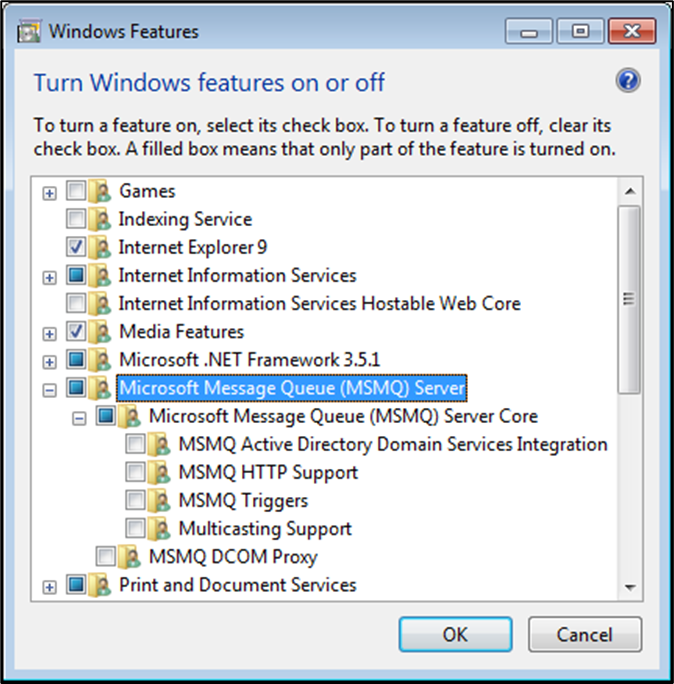
To install MSMQ, run OptionalFeatures from a command prompt to open the 'Windows Features' dialog.
In the dialog's feature tree, select the top-level feature 'Microsoft Message Queue (MSMQ) Server.' This also selects the sub-feature 'Microsoft MessageQueue (MSMQ) Server Core.' The dialog should look like this:
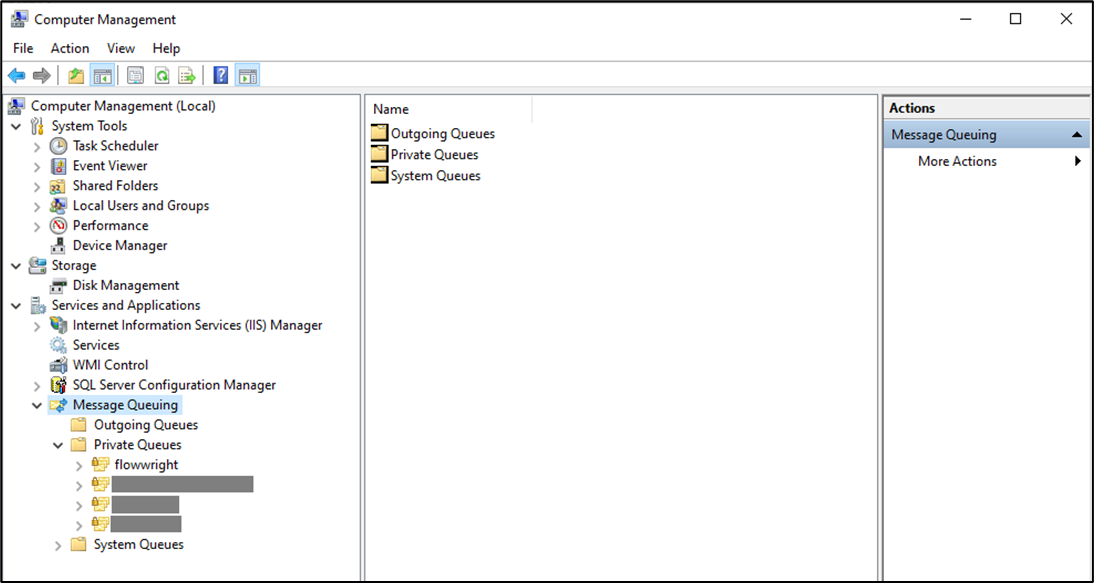
After the message queues are configured in Computer Management, the list is displayed for reference as shown.
Example:
Let’s build and execute the “clsPublishMSMQDef” example.
- Create a new definition named “clsPublishMSMQDef” and open it in designer mode.
- Drag a "clsPublishMSMQ" step to the canvas.
- Connect the dots between the “Start” step and “clsPublishMSMQ” steps, as shown above.
- Click the “clsPublishMSMQ” step to configure its “Required” properties. Enter a name for the step. Enter an MSMQ queue name. Enter the message label and the sample text to send. Click the Save button. Note: Click the "AI Predict" button to have the Copilot add new process steps that match your process description.

- Click the “clsPublishMSMQ” step to configure its “Optional” properties. If the message queue is private, set “No". Then click the Save button.

- The “Logging” configuration is necessary for documentation and also measures workflow progress and percent complete. This is achieved by configuring the step state and percent fields individually, as shown in the images below. Configure the “Logging” using the following properties.

- Save the process definition, create a new instance, and execute it. The process step should publish or send messages to the queue as configured.
Definition Sample:
You may download the sample definition(s) from the link provided and later import them (drag-and-drop) into your FlowWright Process Definition (XML file) or Form Definition (HTML file) page.
Note: Please verify and complete the process steps for any missing configurations, such as file path references and database connections, after the import. Then, save the definition to confirm the changes.