Description:
The Get Process Users Full Names step enables a FlowWright workflow to retrieve the full names of multiple users based on their usernames or process user IDs.
Many business processes store user identifiers rather than display names. While identifiers are suitable for internal processing, user-friendly reports, approval summaries, emails, and generated documents typically require full names. This step resolves multiple user identifiers into readable full names and stores the results in a workflow variable or global variable for later use.
The step accepts one or more user names or process user IDs and returns their corresponding full names. This is particularly useful in workflows involving multiple approvers, reviewers, participants, or task assignees where several user names must be displayed together.
Typical uses include:
- Displaying approval participant names
- Generating workflow summary reports
- Building notification recipient lists
- Creating audit reports
- Populating approval history
- Producing workflow documents
- Displaying task assignment information
- Preparing business correspondence
This step enables organizations to present meaningful user information throughout enterprise workflows without exposing internal user identifiers.
Inputs
- User Names or Process User IDs - Specifies one or more user names or process user IDs whose full names should be retrieved. This property is required.
- Variable/Global to Hold the Full Names - Specifies the workflow variable or global variable that will receive the resolved full names. This property is required.
Returns
- True – The full names of the specified users were successfully retrieved and stored in the configured workflow variable or global variable. Workflow execution continues through the success path.
- False – One or more user names or process user IDs could not be resolved because of invalid identifiers, missing users, or another execution error. Workflow execution follows the alternate path.
Usage:
The Get Process Users Full Names step is typically used before generating reports, displaying participant information, sending notifications, or creating workflow documents.
During execution:
- Read the supplied user names or process user IDs.
- Resolve each identifier to its corresponding full name.
- Store the resulting collection of full names in the configured workflow variable or global variable.
- Continue workflow execution through either the True or False return path.
A typical workflow might look like this:

Typical workflow scenarios include:
- Displaying multiple approver names
- Creating participant lists
- Preparing workflow history reports
- Generating approval summaries
- Building notification messages
- Displaying task assignment information
- Producing management reports
- Creating workflow documentation
Example:
Let’s build and execute the “getUsersFullNamesDef” example.
- Create a new definition called “getUsersFullNamesDef” and open the definition in designer mode.
- Drag a "getUsersFullNames" control to the canvas.
- Connect the dots between the “Start” step and “getUsersFullNames” steps, as shown above.
- Select the line between the steps to configure the “Connection Properties”. The default property values are “None, True, False, Error, and Evaluate”. Depending on the step’s purpose, additional values are available for configuration.
- Define a variable or a global to store the result.
- Click the “getUsersFullNames” step to configure its “Required” properties. Provide a name for the step. Provide the user names and user GUID IDs, separated by semicolons. Provide the variable or global reference to store the user's full name after execution.

- The “Logging” configuration is necessary for documentation and also measures workflow progress and percent complete. This is achieved by configuring the step state and percent fields individually, as shown in the images below. Configure the “Logging” using the following properties.

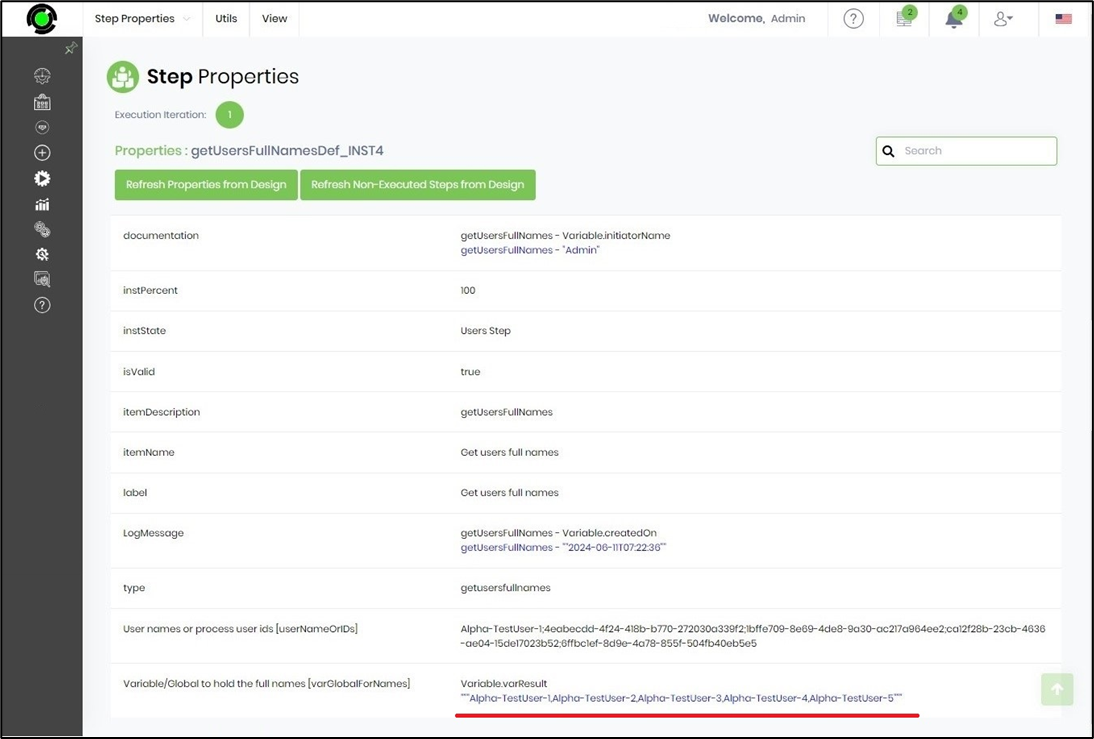
- Save the process definition, create a new instance, and execute it. Render the process instance. Click the process step to view its properties. The getUsersFullNames step should retrieve the users' full names, as shown in the graphic below.
Tips:
- Use this step whenever workflow output is intended for business users rather than system administrators.
- Resolve user names before generating reports, PDF documents, dashboards, or email notifications.
- Store the resulting names in a global variable when multiple workflow branches require the same information.
- Validate user identifiers before attempting to resolve them.
- Route the False execution path to logging and notification activities for easier troubleshooting.
- Combine this step with Send Email, Generate PDF, Approval History, Create Report, ProcessInstanceAuditReport, and document generation steps to produce user-friendly workflow output.
Notes:
- The User Names or Process User IDs property is required.
- The Variable/Global to Hold the Full Names property is required.
- The step resolves multiple user identifiers into their corresponding full names.
- The resolved names are stored in the configured workflow variable or global variable.
- The original user names or process user IDs are not modified.
- Both the True and False execution paths should be implemented for complete workflow handling.
Get Process Users Full Names vs. Get Process User Full Name:
Although both workflow steps retrieve users' full names from FlowWright, they differ in the number of users they process and the format of the results returned.
| Get Process Users Full Names | Get Process User Full Name |
|---|---|
| Retrieves the full names of multiple users in a single step. | Retrieves the full name of one user. |
| Accepts User Names or Process User IDs as input. | Accepts a single User Name or Process User ID as input. |
| Stores the resulting collection of full names in a workflow variable or global variable. | Stores a single user's full name in a workflow variable or global variable. |
| Designed for participant lists, approval chains, reports, and notifications involving multiple users. | Designed for workflows that need the display name of a single initiator, approver, assignee, or task owner. |
| Resolves multiple user identifiers during a single workflow execution. | Resolves one user identifier during a single workflow execution. |
As a general guideline:
- Use Get Process Users Full Names when a workflow needs to resolve and display the names of multiple users.
- Use Get Process User Full Name when only a single user's display name is required.
Definition Sample:
You may download the sample workflow definition from the link provided and import it into your FlowWright environment.
Note: Verify and complete any missing configuration after importing the sample, including:
- User names or process user IDs
- Variable/Global to hold the resolved full names
- Success and failure workflow branches
After verifying the configuration, save and publish the workflow before execution.