Description:
This widget displays a table control that lets you embed other controls within it.
Inputs
- ID/Name - Name of widget generated by FlowWright (read-only field)
- Table Width (px) - Enter the pixel value for width
- Border - Select between any border types (Solid, Dotted, Dashed, None)
- Background - Select between any background types (Transparent, Gray, Light Gray, White)
- Add Row - Add Row, before or after, the current mouse cursor
- Add Column - Add Column before or after the current mouse cursor
- Alignment - Select between the alignment position (Left, Center, Right)
- Column Width (px) - Enter the pixel value for width. Select the checkbox for the entire column width.
- Column Span - Enter a value for column-span
- Row Span - Enter the value for the row span
- Hide - Select the checkbox to Hide (tick mark)
- Save - Save the input values
- Delete - Remove this form widget from the designer page
- Delete Column - Delete the column at the current mouse cursor
- Delete Row - Delete row at the current row cursor
- Close - Close the input popup window
Design:

Example:
Let’s build and execute the “TableDef” example.
- Create a new Form Definition called “TableDef.”
- Drag a “Table and Submit” control onto the canvas and arrange it as shown below.

- Double-click the “Table” widget to configure the “Settings” properties. The application shows the control name. The UI lets you add rows and columns and place them before or after as needed. Click the checkbox to hide the control at runtime. Click the Save button.

- Double-click the “Table” widget to configure the “Styling” properties. You can change the table’s pixel width by overwriting the display value. Select the border and background options from the drop-down list. Use the alignment buttons to format the cell contents as needed. Enter the row and column span values as required. Click the Save button.

- Select the “Table” control and right-click to open the context menu shown below.

- With the Table widget, you can add a line widget as a separator between rows to improve the visual appeal. The Form design view is shown below.
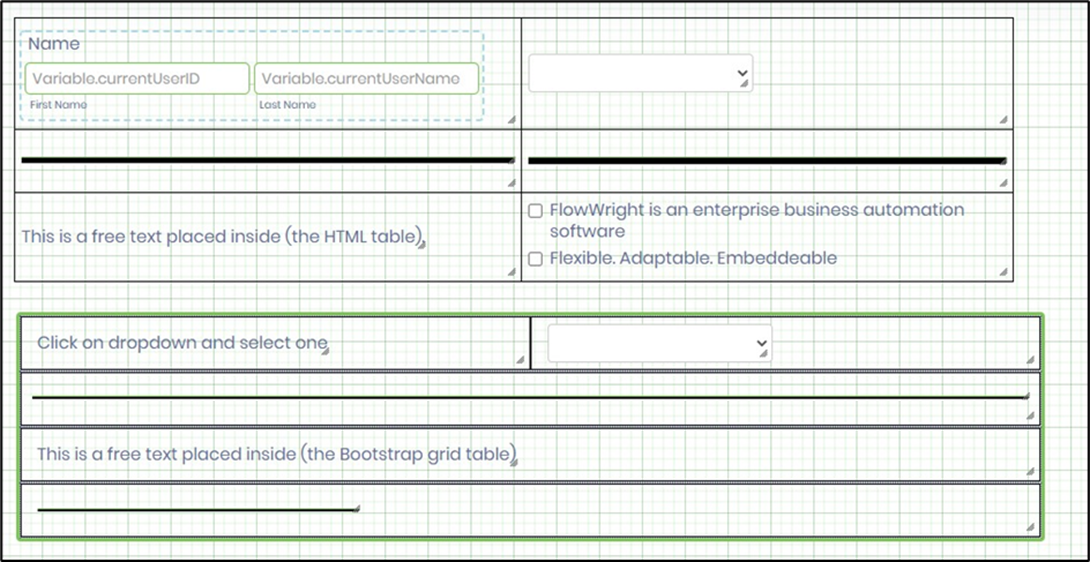
- Save the Form definition. Choose Actions > Create Form Instance from the menu. Generate a new form instance and check the box to edit it.
- The Form is displayed to the user as shown below.
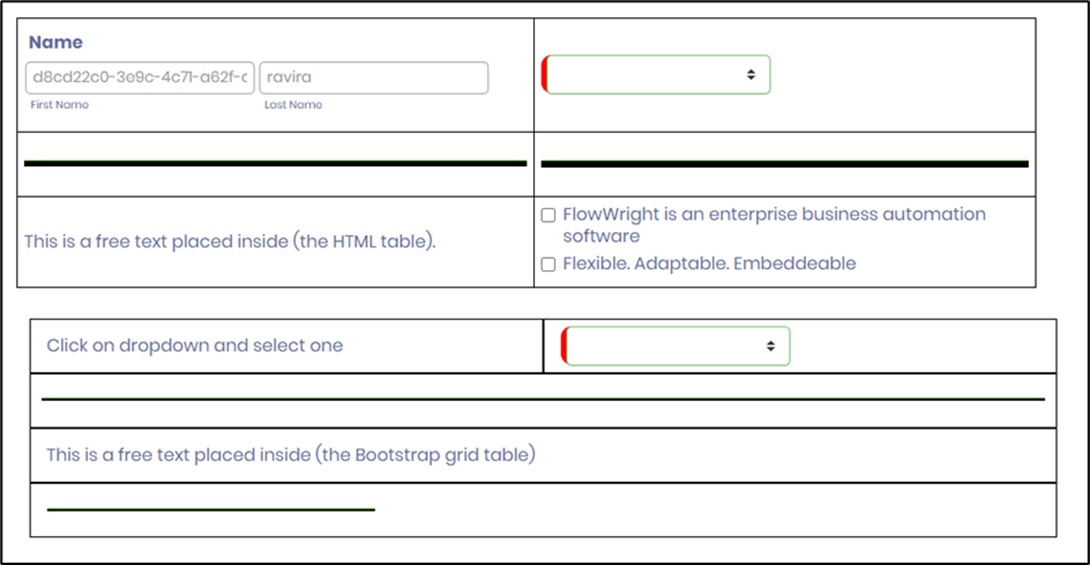
Definition Sample:
You may download and extract the sample definition(s) from the link provided and later import them (drag-and-drop) into your FlowWright Process Definition (XML file) or Form Definition (HTML file) page.
Note: Please verify and complete the process steps for any missing configurations, such as file path references and database connections, after the import. Then, save the definition to confirm the changes.